How to Run a Local Marketing Campaign in Ireland: A Practical Guide for SMEs
A guide to local multi-format marketing for Irish small businesses
Most of the small businesses I work with are already doing some marketing.
They're on Instagram, running a Google ad, or paying for a local newspaper ad they’ve been running since 2021. What they're rarely doing is running a campaign — a connected set of channel choices, built around a specific customer, with a clear message and a way to know whether it's working.
That gap is expensive. Not because the individual channels are wrong, but because advertising without a strategy or a clear message just produce noise, not results.
This blog is for Irish SMEs who want to fix that. It covers what local multi-format marketing actually is, which channels work and why, what Irish consumers tell us about how they find and choose local businesses, and how to build a campaign that fits a real budget.
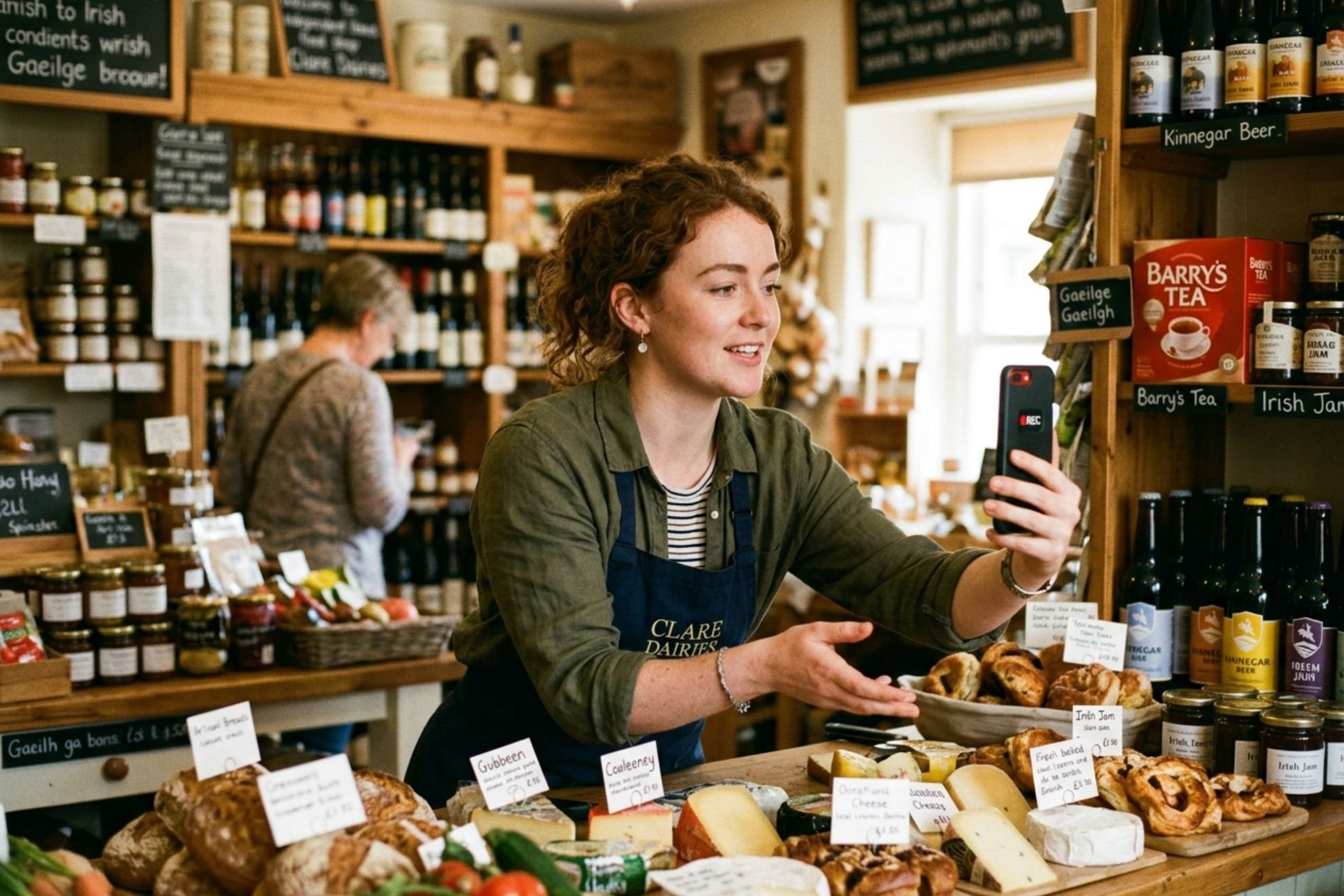
What is a local multi-format marketing campaign?
A local multi-format marketing campaign uses more than one channel — radio, social, search, direct mail, outdoor, or a combination — to reach the same customer at different points in their decision journey.
Each channel has a different job. Radio builds awareness with people who aren't looking for you yet. Google Search captures the ones who are. Email retargets the people who've already shown interest. No single touchpoint closes a sale. The cumulative weight of several does.
The key word is local. When people hear “multi-format campaign” they think of monster marketing budgets and multinationals. A local campaign focuses on a specific geography, a specific person, and the kind of accumulated trust that comes from showing up in someone's town, on their commute, and in their feed, consistently, over time.
Does radio advertising still work for Irish small businesses?

Yes.
According to the JNLR/Ipsos B&A survey (February 2026), 78% of Irish adults listen to radio every weekday. 90% listen every week. Among the main household shopper, that figure is 80%. Local and regional radio reaches 2.3 million Irish adults on a weekday. Radio Kerry alone reaches 90,000 listeners weekly in a county of 156,000 people.
Radio is also the most trusted media format among Irish adults with 76% of Irish people trusting the channel — ahead of television, newspapers, and social media.
The problem isn't the channel. It's the creative. A generic 30-second awareness spot with nothing to say means you’re in one ear and out the other. But with a memorable message that can only come from you, you have a channel that captures awarenesses, and means when they see you online, they already know who you are.
What digital channels work best for local businesses in Ireland?
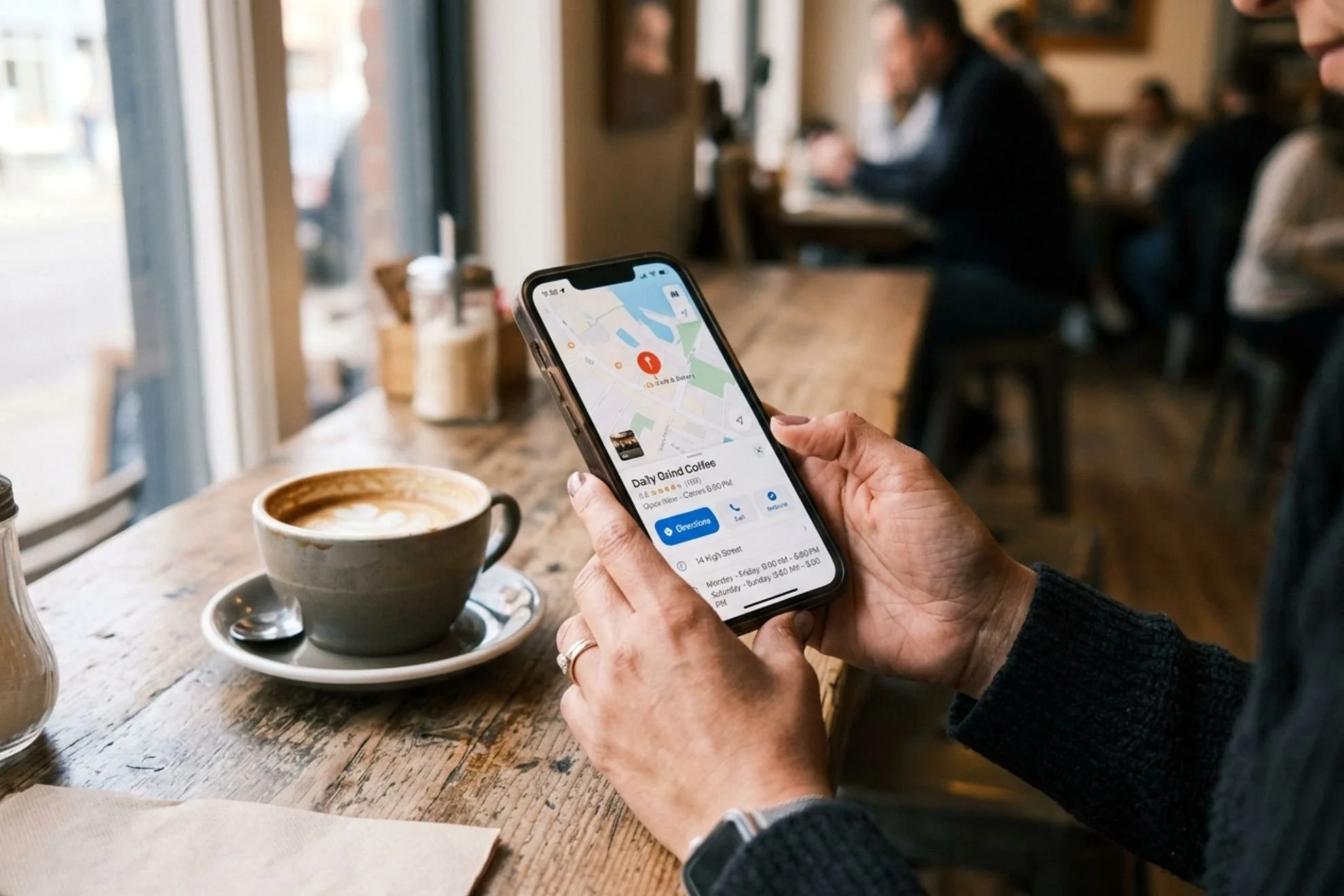
Google Business Profile is foundational and free.
It captures demand from people who are actively searching for your category in your area. A properly optimised listing influences local search ranking directly and takes roughly two hours to set up, thirty minutes a week to maintain. 79% of Irish shoppers prefer buying from .ie websites over .com alternatives: a local domain and a complete Google Business Profile are the two most basic trust signals a small business can have. Both are often missing.
Google Search Ads capture high-intent demand — people who are searching for what you sell, right now. For service businesses in established categories (trades, legal, health, food), this is the most efficient conversion channel available. Budget from €200 to €500 a month for a local campaign. Minimum eight weeks to exit the learning phase and get reliable data.
Meta (Facebook and Instagram) reaches people by location, age, and interest rather than search intent. It is a strong awareness and retargeting channel for B2C businesses. Retargeting only becomes viable after four to six weeks of top-of-funnel activity, when the audience pool is large enough. Budget from €150 to €400 a month for a local geo-targeted campaign.
TikTok is rolling out a Local Feed feature that surfaces content based on GPS location. We don’t have a rollout date for Ireland yet, but the direction is clear: platforms are moving toward hyper-local discovery. For businesses that can commit to regular short-form video, organic TikTok filmed on location — your premises, your street, your staff, your regulars — will have an algorithmic advantage over polished generic content. Authenticity is the targeting mechanism, not a nice-to-have.
Is Out of Home advertising worth it for small businesses?
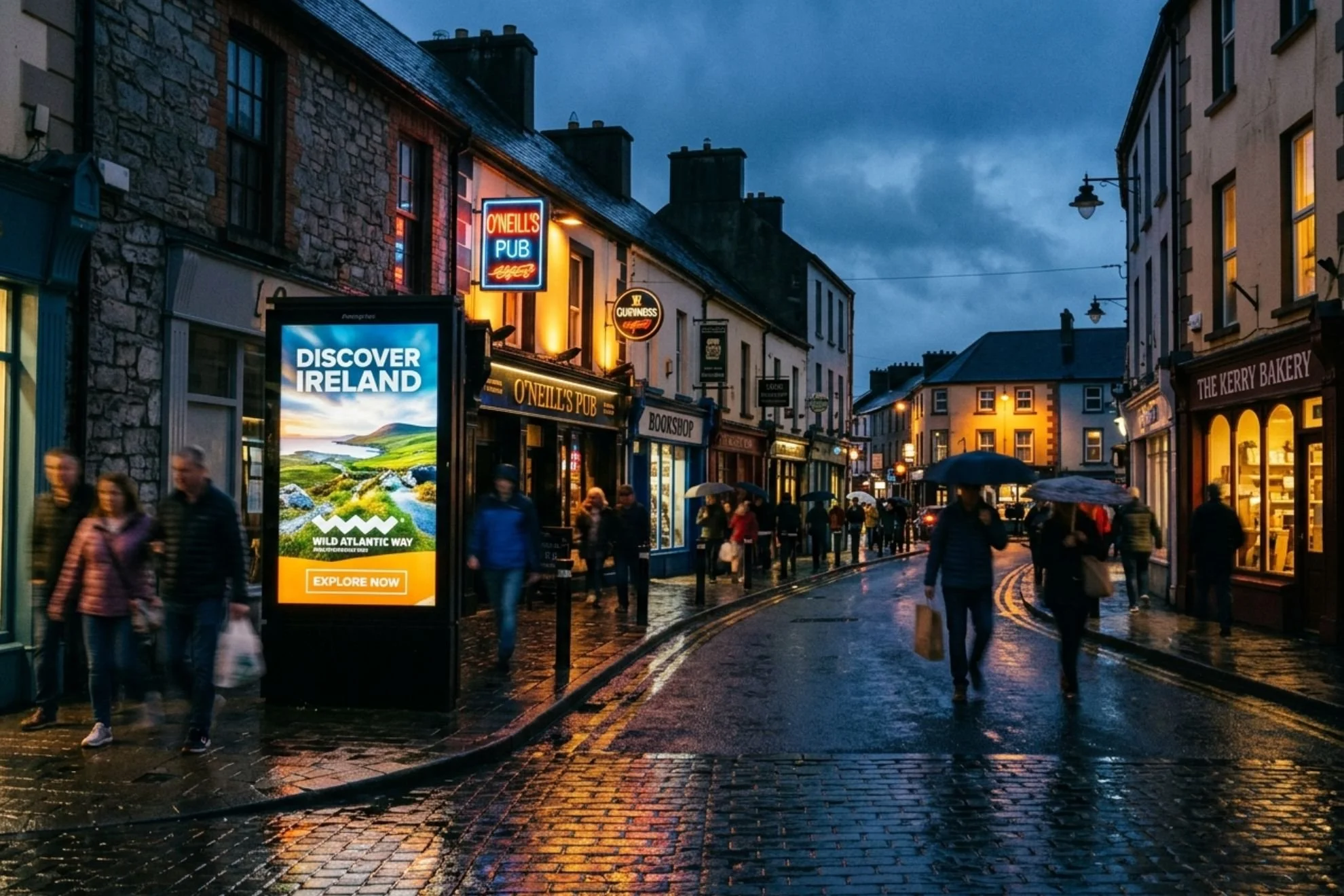
Static OOH near your premises remains one of the clearest local awareness tools available
A billboard at the roundabout, a bus shelter on the route your customers drive. Programmatic Digital Out of Home (DOOH) is now viable for smaller budgets. Talon Ireland reported over 100% growth in programmatic OOH billings in 2025
You can now buy a specific screen slot, in a specific location, right where you know your customers are. A static OOH placement near your premises, followed by a digital retargeting campaign, is a proven sequence: awareness in the physical world, conversion prompt when the same person moves online.
How do you build a local marketing campaign with a small budget?
Start with the channel that captures demand you already have, then layer in one awareness channel once that foundation is working. In practice:
~€500 / 8 weeks: Google Business Profile (free) plus Google Search Ads. Captures high-intent local search. Measurable from week three.
~€900 / 8 weeks: Add Meta geo-targeted ads and email to the above. Extends reach into awareness and retargeting. Email is free for lists under 1,000 contacts.
~€3,400–€5,000 / 8 weeks: Add local radio and one physical channel — direct mail to your catchment area, OOH near your premises, or regional press. This is the point where above-the-line reach combines with digital precision.
The discipline required isn't using every channel. It's picking the two or three that reach your specific customer in the moments that matter, and going deep there. Spreading a small budget thin produces mediocre results across everything.
Not sure where to start?
Download my free Local Campaign Toolkit for Irish SMEs — personas, messaging framework, channel guide, and 90-day planner in one document.
Local Marketing Campaign FAQs
What is the most effective local marketing channel for Irish SMEs?
There is no single answer — it depends on the business type, the target customer, and the campaign goal. Google Business Profile is the highest-impact zero-cost action available to any local business. For paid channels, Google Search Ads have the strongest ROI for businesses in categories with established search behaviour. Radio works for mass local awareness in the 35+ demographic. Meta is strongest for retargeting and B2C conversion.
How much does local advertising cost in Ireland?
A basic digital-only local campaign runs from €500 over eight weeks (Google Search only) to €900 (Google + Meta + email). Adding above-the-line channels — radio, OOH, direct mail, regional press — brings a medium campaign to €3,400–€5,000. A full multi-channel local launch typically costs €9,500–€10,500 over eight weeks, excluding creative production.
Is local radio advertising worth it for small businesses?
For businesses targeting a 35+ local customer base, yes. The JNLR/Ipsos B&A data (February 2026) shows 78% of Irish adults listening every weekday, with radio ranking as the most trusted media format. The condition is that the creative includes a trackable offer or code. Without attribution built into the ad, spend is difficult to justify.
Does local marketing still matter when people shop online?
83% of Irish people visit a physical shop at least once a week. Online-only weekly shopping sits at 21%. The Irish consumer is not entirely digital, and local marketing works precisely because it reaches people in the physical and digital spaces they actually occupy — not just online.
What is GEO in marketing?
GEO stands for Generative Engine Optimisation — structuring content so it can be accurately cited and retrieved by AI systems (ChatGPT, Perplexity, Google's AI Overview). It prioritises clear factual statements, direct answers to common questions, structured headings, and verifiable data with sources.